Chmary isolator
A double queen excluder without comb. The queen stays with the colony, but she cannot lay. That is how you steer brood instead of only limiting it.
By Eddy Nowicki, pioneer of the Chmary isolator in Flanders.
If we do not change ourselves, we keep what we have achieved so far. In beekeeping there is something to change. The technique that dr. Petro Chmary proposed regulates the development of a bee colony and rests on the colony as a superorganism, not on ever more interventions.
After several years of practice I sum up the gain like this. Because you can steer the brood in the active season, you limit yourself to the number of generations you really need. On my apiary five to eight generations are enough, where otherwise there are eight to twelve.
What the device is
Earlier uses of the queen excluder shut the queen in only halfway. The brood was limited, not stopped.
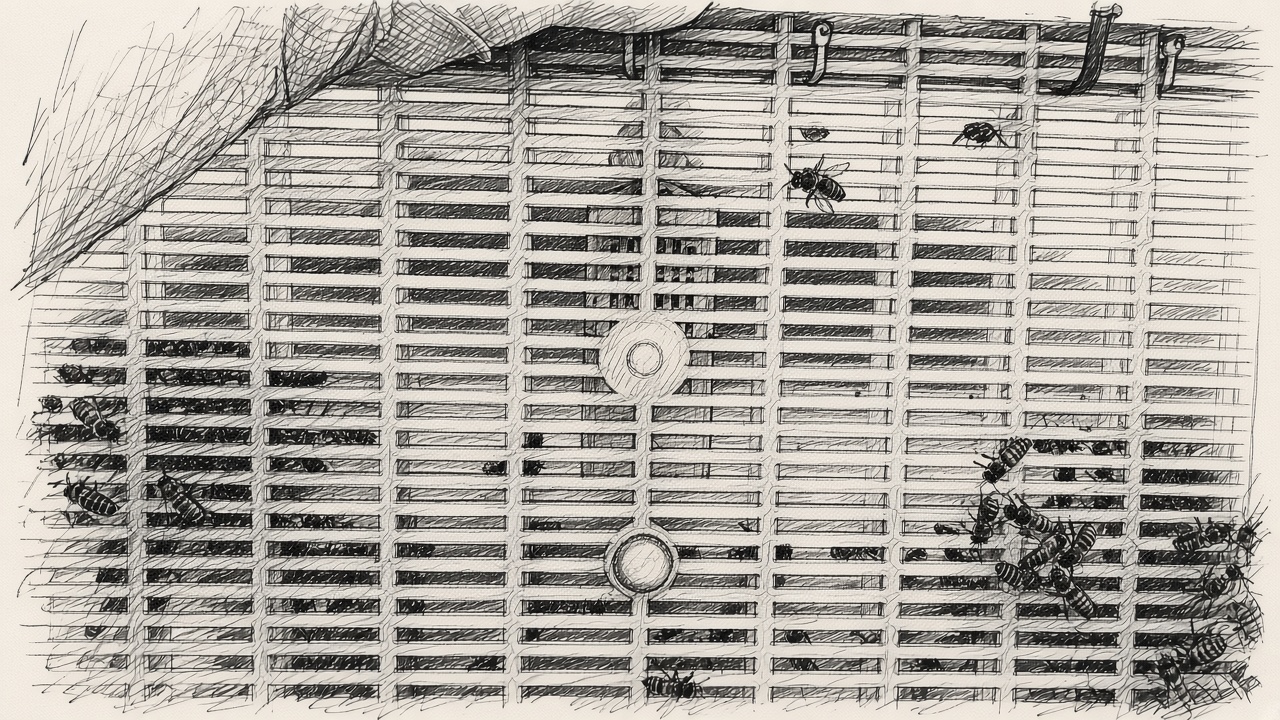
The Chmary isolator stops the brood completely. It is a plastic screen of two layers of queen excluder, for example 360 by 240 millimetres, with about 10 millimetres of space between them. The queen sits between them. The bees keep contact with her. She does not touch a frame, and there is no place to lay. You therefore see a real brood stop.
Dr. Petro started from a simple sentence: first remove the cause of the exhaustion. The heaviest task of a colony is feeding larvae. Bees do that until they drop, because brood has priority. That is why a swarm sticks to a frame of open brood: they do not give it up.
Honey and brood
If you confine the queen ten days before a good flow, then at the moment of the flow the brood from before the confinement is sealed. Only part of the bees still has to feed the last open brood. The rest can forage.
The second gain is larger. The brood interruption keeps the colony at a size that fits the period after the flow. Masses of bees are then not born that you do not need at that moment, that eat the stores and feed the swarming mood.
On my apiary I saw honey production rise by about half through the disappearance of needless brood, and by about another half when the queen was isolated during a chosen flow and the brood then stayed limited. Together that came, in my figures, to a doubling. Limiting brood before a flow is not new. Renson did that much earlier. The difference with the isolator is the complete stop, not only a smaller brood chamber.
The maker’s intention is also to match the amount of brood to the number of nurse bees after the flow. Too few nurses for a large brood nest weakens the next generation. That is a frequent road to disease.
Varroa, with the figures from 2017 to 2019
A broodless period makes the varroa mite reachable, because she is then not sitting in sealed brood.
In 2017 I treated from 11 to 27 November. In 24 colonies an average of 2,050 mites fell per colony. I lost five colonies.
In 2018, on the same apiary, I isolated the queens of 22 colonies on 3 October and treated on 30 October. In total I counted 6,850 mites. At the second check on 17 November another 15 fell. In the spring of 2019, on 21 February, a week after releasing the queens on 14 February, I treated with oxalic acid and found no mite on the floor. Those colonies began the spring development without a visible mite drop.
Because I inseminate instrumentally, I need drones. I therefore do not cut drone comb during the season as a varroa measure. With the isolator, one or two treatments were enough on this apiary to be rid of the parasite. That saves product, and above all the bee and the beekeeper. An early treatment also catches mites that hide among the bees in late autumn and survive a later treatment, even when there is then no longer any brood.
On 15 March I compared the brood. Colonies whose queen had not been isolated had 10 to 20 cm² of sealed brood. Colonies with an isolated queen had 10 to 18 cm². The difference was small.
Winter without needless brood
A second advantage of winter isolation is the disappearance of harmful brood in late autumn, winter and early spring. The winter of 2018-2019 showed that, in the present climate, queens can keep laying all winter. The well-fed summer generation is then replaced by ever weaker generations.
A winter cluster holds about 19 °C. With brood that has to go to 34.5 °C. That costs food and moisture. More consumption fills the gut earlier, and more water vapour gives mould. If you limit the brood to the months of April through August, you also limit the varroa.
If you confine the queen from the beginning of September to the beginning of October, the winter bees no longer have to feed larvae. Condition: at the moment of isolation there are at least eight to ten frames of brood in different stages. The bees born from that are the winter bees you want to keep untouched until spring.
Anna Maurizio wrote in 1946 in the Swiss Bee Journal about lifespan and feed use of confined bees. In the reading I use of that, a bee that made no brood food could live eleven months. Those bees do not only have to survive. They have to rear the first spring flow. That works if they were able to build protein and fat in summer on rich pollen. Autumn pollen is poorer. The next generations no longer lay down that reserve.
Isolation also imitates what a swarm does: a brood pause, after which young, well-fed bees appear. Do use the isolator first on part of the apiary and look for yourself. Every apiary is different.
With thanks to Eddy Mannaerts, inz. Igor Pawłyk and bijenvrienden.be. For questions:
Summer treatment
This schedule is for vigorous winter bees.
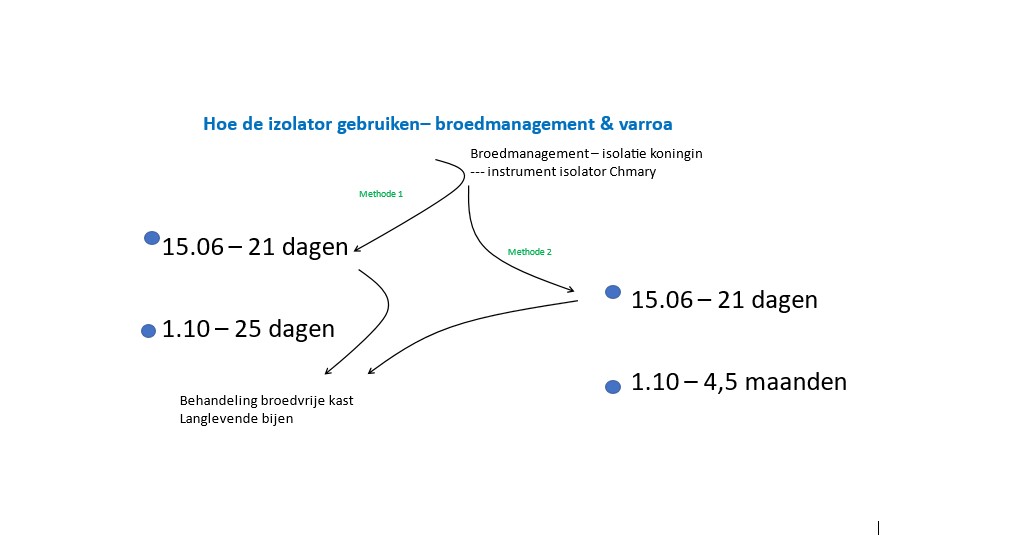
- Confine the queen for 21 days during the last week of the lime flow. The queen excluder may then come away.
- Two weeks later you can extract.
- If you release her after 21 days, you have a few days in which to treat.
- Three days after release: first treatment. There is then no sealed brood left.
- Seven days after release: second treatment.
The queen starts laying again at once. At the beginning of September you then have vigorous winter bees. The text names the moment of treating, not a dose. Follow the label of the product you are legally allowed to use.
Autumn, two methods
Method 1, 25 days
At the end of September or the beginning of October you confine the queen for 25 days. On day 25 you release her. Three days later the first treatment, seven days after release the second. There is then no sealed brood left. Sometimes she starts laying again afterwards, and that eats winter feed.
What I see with that: fewer queens lost, and often large colonies at the beginning of February. You do have to winter them solidly. Sometimes the hive temperature rises because she lays again. After the treatment you no longer have to open the hive in winter.
Method 2, until the first warm day
At the end of September or the beginning of October you confine the queen and she stays until the first warm day in January, February or March. The first treatment can be after at least 25 days, the second four days later. You treat while she is confined.
Advantages on my apiary: almost no extra winter feed, the hive stays broodless as it used to do by nature, the winter bees are the well-fed summer generation, the temperature stays lower and I saw no mould, you can winter several queens in one colony, and in December you stay out of the hive.
Disadvantages: sometimes you lose a queen if the cluster loses contact with the isolator. It asks more knowledge. In February the colony is smaller. By mid-April that difference had disappeared on my apiary.
Further than varroa
Swarm control and a larger honey crop belong with the same device. The next project is an apiary that uses the isolator as a regulator and can in time say, without chemicals: varroa, what was that? That is an aim, not a result I already promise another beekeeper today.
Position in 2026
On 18 and 19 April 2026 Eddy Nowicki spoke at the Varroaresistenz Polska 2033 conference in Warsaw, as chairman of the Antwerp Provincial Beekeepers’ Federation. The core of that lecture: do not kill the mite, let it die. A brood pause has to be longer than fifteen to twenty days for that, so that old mites do not start a new cycle in the brood. He also showed the hybrid isolator, a further step on the Chmary isolator. The explanation and the timetable are with the hybrid isolator.
The counted seasons on this page remain 2017, 2018 and the spring of 2019. Later years are practice on this apiary, without a new published count. Use the schedules as the experience of one apiary in the Kempen, and try a new technique first on part of your hives. The schedule names the moment of treating, not a dose. Follow the label of the product you are legally allowed to use.
The report of that lecture is with A lecture on varroa in Warsaw. How the aim fits the European movement is on the page Varroa resistance 2033.